Overview of the sIRB at the UI
Asking Questions about Suicidality in Research
Herky Hint: Risk of Harm to Self or Others
Overview of the sIRB at the UI
By Jarrod Feld, BA
Since January 2020, non-exempt, multi-site human research studies funded by NIH and other federal agencies require all sites working under the same protocol use a single IRB (sIRB) of record. Exceptions include:
Sites located outside the United States.
Sites where sIRB review is prohibited by federal, tribal, or state regulations (including Veterans Affairs sites).
Career development (K type), research training (T), or fellowship (F) grants.
Exceptions made by the funding agency for a compelling reason (extremely rare).
There are a number of steps in the process of establishing a collaborative study under the sIRB format.
Pre-Grant Submission Survey
If a researcher at the UI intends to apply for a grant that may require the University of Iowa to serve as the single IRB of record over other sites, the Human Subjects Office (HSO) requires the UI Principal Investigator (PI) to submit a pre-grant submission survey to provide information about the proposed study. This information helps the HSO determine whether the UI IRB can serve as the lead IRB for the study and helps the researcher to budget for IRB fees. Note: the HSO requires at least 14 days to review any sIRB requests.
UI as the Reviewing Site
There are several considerations the PI should keep in mind when thinking about the UI serving as the reviewing site for a study. These include:
Utilizing the SmartIRB platform, which nearly one thousand other institutions have also agreed to use. (If a potential relying site does not use SmartIRB, there are other options for establishing reliance.)
Understanding the UI’s role as the lead site/reviewing IRB.
The capacity and location of potential relying sites (e.g., Iowa cannot serve as lead IRB for any California sites).
A thorough communication plan for the sites, and their respective IRBs.
Ensuring IRB fees are incorporated into the grant to cover IRB review costs for relying sites engaged in research.
The HSO has specific requirements and expectations for proposed research with a single IRB, especially when the UI is the IRB of record. The PI and study team will be expected to meet with HSO staff for an onboarding meeting after a grant award notice is made. Additional meetings may be requested during the initial study review in HawkIRB or when adding relying sites to the study. Best practice is for the UI team to obtain IRB approval for their local study activities first, then add relying sites, one at a time, via subsequent modifications to the study.
Relying on another IRB
If another site approaches a UI researcher to potentially rely on their IRB, there are important considerations for this type of reliance, including:
The lead IRB’s policies and expectations.
How documents will be submitted to and received from the lead site/IRB.
The reviewing site’s plan for communicating with UI researchers.
Communication with the HSO
Single IRB studies can become very complex for a variety of reasons, including: the number of stakeholders involved across all sites, the complexity of procedures, local context considerations at sites in other states, and the amount of documentation to be completed and submitted for review. Regardless of whether the UI is the reviewing site or the relying site, the most important factor for any study that uses sIRB review is to maintain close communication with the HSO.
More information is available in this presentation, and on the External and Central IRB Reliance Models page of the HSO website. IRB fees can be found on the IRB fee page of the HSO website. Contact the external IRB team at UIRB-External@uiowa.edu.
Asking Question about Suicidality in Research
By Emily Shultz, CIP
Research surveys and interviews occasionally include questions that ask the participant about their own suicidal thoughts or prior suicide behaviors. Depending on the focus of the research and the participant population, some questions may cause emotional or psychological distress and/or risk of self-harm for some participants.
Although studies indicate that asking questions about suicidality does not directly lead to an increased risk of self-harm, researchers need to establish a specific plan to provide resources and/or obtain immediate care for participants who answer affirmatively to current or recent suicidal thoughts/behaviors. The project description in HawkIRB should include the plan for training any study team members who will be involved in:
the assessment of the participant responses, and
implementation of the follow up plan, as appropriate.
In some cases, the IRB may require additional timely monitoring of participants’ responses to suicidality questions to reduce the potential risk to participants’ emotional or psychological distress, or to address imminent risk of harm to self.
Considerations for research that includes questions about suicide include:
What are the risks to participants when asking about suicide/suicidal thoughts?
What survey responses require monitoring and immediate action by the research team?
What information needs to be included in the project description regarding the researcher response when suicidal ideation/behaviors are identified?
What must be included in the consent document?
What resources will be provided to participants?
UI IRB Policies and Guidance
The IRB provides the following policies and guidance in the UI Standard Operating Procedures and Researcher Guide addressing risk of harm to self:
Section I, Part 8.A.vii Intent to hurt oneself or others
Common law (not statute) generally requires that one report a demonstration of a current intent to hurt oneself or others
Section II, Part 13.A.i Suicidality and IRB expectations
In its review of studies, the IRB complies and expects investigators to comply with Iowa common law (not statute) which generally requires that one report a demonstration of a current intent to hurt oneself or others.
Based on the nature of study and subject population, the investigator may be asked to describe a response plan in the HawkIRB application and Consent Document if subjects may be identified as suicidal or at risk of harming themselves or others.
Including Suicidality Questions
Depending on the focus of the research, the principal investigator may wish to consider whether questions about suicidality need to be included at all. If the questions are central to the aims of the research, the questions are justified and should be included. However, if questions of suicidality are only peripheral to the research questions, the researcher may wish to exercise one of the following options in order to reduce the potential risk to participants:
a. remove an entire questionnaire/scale
b. remove an individual item on a questionnaire/scale
c. replace a questionnaire/scale with one that doesn’t include suicidality questions.
Monitoring and Follow-up
Studies that include questions or questionnaires that focus on suicidal ideation or behaviors must include a plan for timely follow up in the study procedures (HawkIRB Section VII.E.6) and steps to minimize risks to participants (HawkIRB Section VIII.2). The risks of the questions and the planned follow-up procedures will also need to be provided to the participant in the consent document.
The consent language should include:
The survey/interview contains questions that could be sensitive or difficult.
The participant can refuse to answer any questions that make them uncomfortable.
A list of available resources can be\will be provided.
When direct intervention by a research team member may be necessary, and what steps will be taken
The ways in which the study team can manage and monitor risk will depend upon the type of intervention:
Anonymous survey
If participant responses will not be individually identified, the investigators should include in the project description an explanation for why identifiable assessment is not necessary. Because no follow-up is possible, the potential risk to anonymous participants should be considered and weighed against other factors.
For anonymous surveys, the consent form should (a) inform participants explicitly about the specific topics on the survey (e.g., suicide, self-harm) and (b) clarify that the researcher cannot connect a participant’s answer to the person and (c) refer directly to the resource referral information.
Non-anonymous online survey
If participants’ responses to an online survey will maintain an identifiable link to the individual, the project description must provide information about when and how the research team will contact and conduct further assessment for those who endorse suicidality through responses. The informed consent form must explicitly state that the research team will review responses and what actions will be taken if there appears to be a significant risk of self-harm. The consent should also explain that confidentiality may be breached in these circumstances. The project description in HawkIRB should include specific score/response cut-off points and describe the follow-up plan for participants who meet or exceed the threshold.
In-person survey or interview
When questions of suicidality are administered in-person, it should be clear in both the project description and in the informed consent document that the responses to the survey or interview will be examined before the participant leaves the research setting. The investigator will delineate the score/response cut-off points for the responses in the project description. The description should also include the follow-up plan for participants who meet or exceed the threshold. The procedures described in HawkIRB should address who will conduct the assessment and steps that will be taken both if the participant does and does not meet the criteria for imminent risk of harming themselves.
If an imminent risk is present, a qualified member of the research team must remain with the participant until support services arrive. The response may also include staying with the participant and calling 988 or calling campus resources (if in an educational setting), or following policies established by the institution or clinical setting. Providing a resource referral document or telling the participant to go to the emergency room is not sufficient in cases when imminent risk is identified during an in-person study visit.
The informed consent form must explicitly state that based on survey/interview responses, the research team will breach the standard confidentiality protections for research participants if there is a significant risk of self-harm.
Sample consent language
The consent document should address the risk of emotional upset, the safeguards for risk of harm to self, and should also include the planned actions by the research team to address concerns about risk of self-harm. The consent document should also address any limits on the typical confidentiality protections for research participants. Describe these plans in the risk and confidentiality sections, as appropriate.
Additional language might include some or all of the following:
In the Risk section
There are questions in the survey that may be upsetting. You may choose not to answer any questions that make you uncomfortable.
The following resources may be helpful: (Include resources such as UI Counseling Services, local crisis hotlines, or the National Suicide Prevention Hotline at 988.)
In the confidentiality section
It is our intention to maintain the privacy of all research participants and protect the confidentiality of their responses; but there is one exception to maintaining confidentiality. If your responses indicate that you are thinking about harming yourself or others, or if you answer a question in a way that indicates thoughts about harming yourself or others, someone on the research team will contact you and provide assistance. It is our ethical responsibility to report situations of any life-threatening situation to appropriate authorities. If the research team feels that your situation puts you at risk, it may be necessary for ethical or legal reasons for the team member to contact emergency services on your behalf.
Conclusion
When research includes questions about participant suicidality, the researcher must ensure that appropriate safeguards are included that reduce the risk of emotional or psychological distress, and the risk of harm to self.
Study procedures described in HawkIRB should justify the need to ask questions regarding suicide and should provide a complete description of the safeguards for participants. Participants should be provided information in the informed consent document about the risks of emotional or psychological distress and the risk of loss of confidentiality.
For more information about suicidality in research, see this month’s Herky Hint.
Parts of this newsletter article were adapted from Guidance in Suicidality in Human Research Protocols, Northwestern University IRB.
Herky Hint: Risk of Harm to Self or Others
If a research study includes survey or interview questions about mental health, depression, or suicidal ideation, it is important to address the risks to participants and how they will be managed. HawkIRB has several sections where researchers will need to describe the procedures, address the potential risk of harm to self or others, and describe the safeguards the research team has in place to manage the risks.
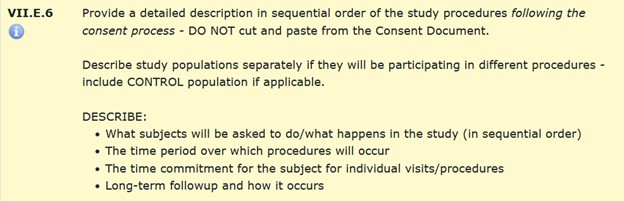
Section VII.E.6 – Study Procedures
In Section VII.E.6 (study procedures), indicate that surveys or interviews include questions about depression or suicidal ideation. The description should indicate how the research team will follow up with participants if there is an indication of distress or they disclose suicidal ideation.
Section VIII - Risks
In Section VIII.1, describe the potential known risks associated with participation in the research study. Indicate which types of risks the subject may encounter (emotional/psychological, financial, legal/social, or physical). Be specific about the emotional and psychological risks. Describe any and all risks associated with participating, this could include; embarrassment, discomfort, loss of confidentiality, discomfort from being asked about sensitive information, disclosure of illegal activities or mental health conditions, specifically the risk of potential emotional discomfort and/or psychological harm caused by asking questions about suicidality and/or depression. Potential risks indicated in Section VIII.1 should also be described in the consent document.

In Section VIII.2, address steps the research team will take to minimize risks to study participants.

Describe how each risk indicated in VIII.1 will be managed. Describe how the research team will monitor the safety of subjects and what resources will be available to maintain subject safety. Describe the research team response plan if there is a potential for the subject to be identified as suicidal or at risk of self-harm or harming others. Plans described to minimize risk in Section VIII.2 should also be described in the consent document.
Consent Language
Potential risks indicated in Section VIII.1 and plans described to minimize risk in Section VIII.1 should also be described in the consent document in the risk section (WHAT ARE THE RISKS OF THIS STUDY?) and in the confidentiality section (WHAT ABOUT CONFIDENTIALITY?).
Note: The HawkIRB consent document template appendix, provides template language suggested for the WHAT ABOUT CONFIDENTIALITY? section regarding “Studies Focusing on Violence, Abuse, or Self-Inflicted Injury” which says,
We will disclose to the proper authority information you share with us concerning harming yourself or others.
For more information and guidance about suicidality in research, see this month’s IRB Connection newsletter article.