Seeking New IRB Members
PI Leaving the UI
New Conflict of Interest in Research Feature in Hawk IRB
Concurrent Human Research Protection Program (HRPP) Review Process to Include External IRBs
The UI Institutional Review Board (IRB) is seeking new members who are willing to provide their expertise to the Human Research Protection Program (HRPP). We invite members of the UI research community to consider serving on the IRB, and to help us spread the word to anyone outside the UI who might be interested in serving as an IRB member. This volunteer opportunity is great for people who care about protecting the rights, safety, and welfare of research participants. IRB members have a front row seat on current research activities, and receive training in research ethics, and the protection of research participants as outlined in regulation, policy, and guidance.
Board members are a dedicated group of people, with varied backgrounds and expertise, who play an essential role the UI Human Research Protection Program by reviewing research proposals and attending IRB meetings. Members make an annual commitment to attend one or two meetings per month
Members have a front row seat to hear about current research activities and the opportunity to learn about research ethics and the protection of research participants.
IRB membership includes people with scientific training and experience, as well as community members with a non-scientific background:
Scientist Members (non-Physician)
The IRB seeks non-physician scientist members on the biomedical and social science boards. If you have a scientific degree or background and are interested in a volunteer opportunity, this may be a way to learn more about protecting human research subjects and contribute to the UI research enterprise.
Community and Non-Scientist Members
Community and non-scientist members play a crucial role by bringing fresh perspectives to the IRB review process. Community members and non-scientist members serve as a “voice” for potential subjects from various backgrounds, to look out for their interests during the IRB review process. UI retirees may qualify as community members two years post-retirement.
More Information
The IRB must also include members with a non-scientific degree, background, or training. That can include clergy, public servants (police officers, fire fighters), artists, business professionals, research participants, and many others. The IRB must have a non-scientist member at every meeting.
No previous experience is necessary. We provide the initial training and ongoing education that you need to serve on the IRB. IRB members are considered a volunteer service.
IRB Membership Expectations
Able to attend IRB meetings during business hours:
IRB-01 meets on Monday and Thursday afternoons (2-4 pm)
IRB-02 typically meets on Wednesday mornings (9-11 am)
An interest in, and general aptitude for, learning about human subjects regulations and institutional policy
Commit to review research proposals prior to IRB meetings
Complete a monthly educational requirement
We hope you will consider serving on the IRB and/or share this article with other people you know who might be interested in this volunteer opportunity To apply to become an IRB member, contact the Human Subjects Office at irb@uiowa.edu or (319)335-6564.
Whether you are a student researcher or a departing faculty member, if you are a principal investigator (PI) on a research study that has been approved by the IRB, and you are planning to leave the UI, you are responsible for submitting either a project closure form or modification form in HawkIRB.
As soon as you know your departure date, you will need to
Submit the appropriate form to the IRB. Either a:
Modification Form to change the PI (if the study is not complete and research activity will continue at the UI under a new PI), or
Project Close Form (if the research will no longer be conducted at the UI).
The study’s associated ClinicalTrials.gov record should also be updated to reflect the PI change if study activities will continue at the UI. If the study is complete and results are not required, the record should be closed. Submit the results if applicable regulations require them. If the study is ongoing and will continue at the PI’s new institution, notify the PRS administrator to initiate a transfer of the active record.
Planning for HawkIRB Access
Once a PI has left the UI, they will no longer have access to the HawkIRB system and are considered “deactivated” when their UI appointment ends. This status depends on their UI employment (HR) or enrollment (registrar) records. If the PI has HawkIRB delegates, the delegates can complete project closure forms and modification forms, but only for the projects to which they have delegate access rights. (See the article in the January 2025 IRB Connection Newsletter for more information on delegates.)
Submit a Modification Form:
The PI or delegate should submit a Modification Form if:
The study is not complete, and a new PI will be named on the application, and/or
To request IRB approval if the PI will take research data/samples to a new institution or plans to have continued access after departure.
To create a Modification form, log into your HawkIRB inbox. Under ‘Projects,’ click on the IRB number of the study you would like to modify.

- Under ‘Create Form’ click on the Modification/Update Form
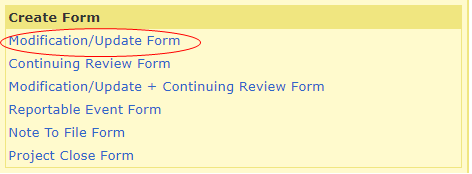
After starting the modification, you will be routed to the Frequent Mods portion of the Modification Index. If you will be sharing data, please see the November 2023 IRB Connection article ‘Best Practices for Research Collaboration and Data Sharing’.
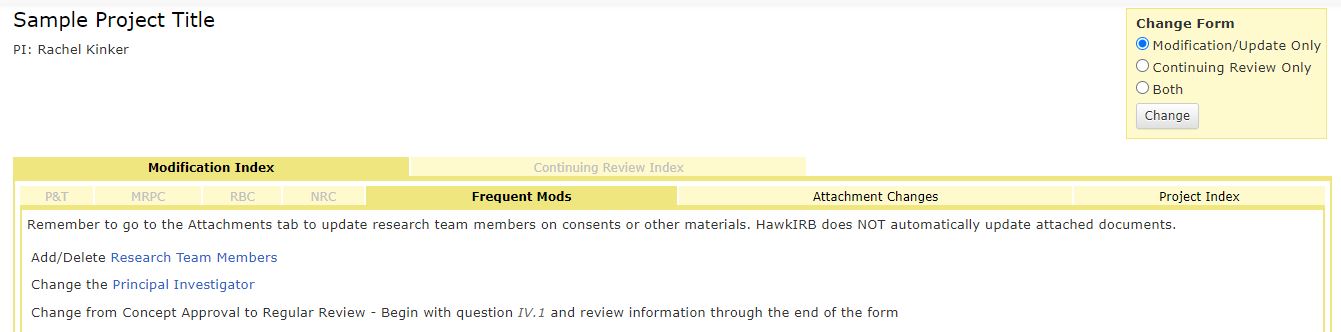
To change the PI, select the option ‘Change the Principal Investigator.’ Enter the information of the new PI and select the ‘Set Principal Investigator’ button and then save the form.
To share or take data from the UI, modify section X.5 and 6. Please see the article November 2023 IRB Connection article ‘Herky Hint: What to do with all that Data? Data Sharing and Security Guidelines’.
To Submit a Project Close Form:
Departing researchers should not close projects unless they have completed all the following:
Protocol-indicated research activities, including interaction with subjects and collection of data or specimens
Collection of data about subjects even when no subject contact is necessary
‘Cleaning’ of data
Analysis of identified or coded data for research purposes or during the publication process
Any other research use of data that involves access to identified or coded data or specimens collected during the conduct of research
To create the form, log into your HawkIRB inbox. Under ‘Projects,’ click on the IRB number of the study you would like to close. Under ‘Create Form,’ generate a Project Close Form.
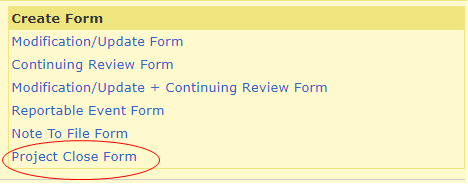
The project will close as soon as the form is submitted, and the research team may no longer collect data about any of the subjects in the study, contact the subjects for research purposes, or work with identified data/samples.
If you will be collecting follow-up data the project should remain open, even if new subjects are not being enrolled. See the UI Guide Sec. II, Part 22. Questions about this topic? You can email the HSO Education and Outreach team or come to Office Hours to speak directly to a member of the HSO team.
Have an idea for an IRB Connection newsletter article? Let us know!
A new feature has been implemented in Hawk IRB that enhances transparency around Conflict of Interest in Research (COIR) reviews. Researchers will now see a dedicated COIR review line within the “Other Committee Review” tab their Hawk IRB applications. This update aligns COIR visibility with other Human Research Protection Program (HRPP) reviews and improves clarity throughout the review and approval process.
What Is a COIR Review?
The COIR review occurs when an individual listed as key personnel on a research team has disclosed a financial interest in the institution’s electronic Conflict of Interest (eCOI) disclosure system.
During the review, staff examine the IRB protocol in detail, including investigational drugs or devices, study sponsors, and any external relationships or data-sharing arrangements. The goal is to determine whether the disclosed financial interest could create actual bias or the appearance of bias in the conduct of the research. This review occurs behind the scenes, but its status is now visible to researchers through the new COIR review line in Hawk IRB.
Potential Outcomes of the COIR Review
If the administrative review determines that no conflict of interest in research exists, the eCOI system is updated accordingly. That determination is then automatically communicated to HawkIRB, populating the “Date Received” field and changing the COIR review status from Pending to Received. This is the most common outcome researchers will see.
If, however, the financial interest is determined to be related to the scope or conduct of the research, an additional level of review is required. In those cases, the application is referred to the Conflict of Interest in Research Committee (CIRC) for committee-level review. This process mirrors the structure and regulatory obligations of the IRB review and may require the development of a conflict management plan. When this occurs, researchers may see a completed COIR line along with a separate CIRC review line marked as pending.
Relationship Between COIR and IRB Approval
The COIR review occurs concurrently with the IRB review. In some cases, IRB approval may be completed before the COIR review is finalized. When this happens, researchers may receive automated notification that IRB approval has been granted; however, the project will not be released until all required HRPP reviews—including COIR—are complete.
How Researchers Can Track Review Status
Researchers and delegates can monitor COIR and other committee reviews in multiple locations within Hawk IRB:
Project Summary Page: Under the project history, the “Other Committee Review” section indicates whether any reviews are pending and prevents release of the application if incomplete.
Other Review Tab: This section lists all required committee reviews and their current statuses.
Pending Forms Dashboard: Icons and color indicators allow for quick status checks:
White clock icon: review not started
Yellow pause icon: review in progress
Orange rewind icon: questions pending for the study team
Green checkmark: review complete
Hovering over an icon provides additional status detail.
Once all required committee reviews show a populated “Date Received” and a status of Received, Hawk IRB automatically releases the approved project to the investigator, enabling the research to begin.
Communication and Ongoing Updates
Automated email notifications continue to be sent when reviews are completed or remain pending. These emails include contact information for the relevant committees and are distributed to principal investigators, delegated team members, and designated contacts listed in Section II of the HawkIRB application.
This enhancement was implemented to better align system messaging with the researcher experience in Hawk IRB and to reduce confusion surrounding pending reviews. Website updates reflecting this new COIR review feature are underway and are expected to be completed in early May.
A simultaneous HRPP review process was instituted a year and a half ago under the IRB Efficiency Initiative to allow IRB-01 and IRB-02 to grant approval before all required HRPP committee reviews were completed. In such cases, the study is placed in an “IRB approved, pending HRPP review” status until all remaining committee approvals are finalized. This process will soon be expanded to include external IRBs.
We are currently testing the application of this parallel review model across all external IRBs. This expansion will include commercial, academic, and nonprofit IRBs similar to how WCG reviews occur now. Pending the resolution of any issues identified during testing, the tentative go-live date for this broader implementation will be in May 2026.
Exceptions to the concurrent model may be made in certain scenarios—such as when concerns are raised by an HRPP committee or when study activities introduce additional complexity—in such circumstances, the completion of particular committee reviews may be required prior to IRB approval.