Updates to HawkIRB Section VII.
Payments to Research Subjects
Part 11-Compliant eConsent
Part 11 Regulations and HawkIRB Consent
Training Changes for Documentation in a Subject's Medical Record
Updates to HawkIRB Section VII.
Overview
As a part of its ongoing efforts to improve application processing times, the HSO recently released updates to HawkIRB section VII. The changes in Sections VII.A, VII. B, VII.C, VII.D, and VII.E were rolled out on February 15th.
Updates to section VII include:
Revisions to include additional checkboxes to select UI Health Care primary physical locations where human subjects research may occur.
Elimination of free text fields, where possible, by adding options.
Inclusion of the ability to upload an attachment directly after a question requiring it has been added as a feature throughout section VII.
All IRB applications will be required to provide responses to the redesigned questions. Where possible, existing responses have been carried over to the newly redesigned structure. However, not all free text field responses were carried over to the new redesign of section VII.
A one-time change to provide details for all redesigned questions in section VII will be required the next time a modification is submitted to the IRB.
All draft IRB applications will automatically be updated to the newly redesigned structure.
All pending forms will not undergo redesign changes until after IRB approval at the time a modification is submitted.
Section VII.A
Section VII.A was revised to include the UI Health Care primary physical locations where human subjects research may occur. This change identifies
200 Hawkins Drive locations such as the Clinical Cancer Center, the Medical Center University (non-oncology locations), and the Stead Family Children's Hospital.
Iowa River Landing (both locations) and the North Liberty Hospital
Mission Cancer + Blood and the Quad Cities Oncology locations
An option for all other UIHC physical locations not identified.
The CRU will remain a standalone selection and is automatically checked if V.21 is Yes.
These changes are to support ongoing enhancement of location details pushed over from HawkIRB to the UIHC Clinical Research and Trials website and to the Iowa Clinical Trial Management System Oncore. The last stage of this development is to update this linkage (expected completion March 2026).
Section VII.B
Revisions to section VII.B includes the following study-related activities, and includes a small number of changes:
Renumbering questions dues to previous section changes. (The section questions about study design and clinical trials moved from VII.B to section I.6-I.13 in the last rollout in August 2025. However, the remaining questions in VII.B did not get renumbered at the time.)
Use of placebo
Separation of one question into two questions to avoid confusion cited by both the IRB and the researchers. This question series has caused additional work for researchers and the IRB when completed incorrectly.
The revisions clarify wording on whether or not there are FDA approved treatments a subject may or may not have available if they were not participating in the research.
Clarification of safety management plan expectations during placebo phase of the research.
Use of an investigational medical device wording update added in one question to reference the device selection as identified in I.6.
Section VII.C
Updates to section VII.C include removal of several free text field questions collecting research related details about genetic testing and replacing them with a "check all that apply" structure offering selections based on
the most common types of genetic testing submitted to the IRB and
the most common types of blood, fluid, or tissues, etc. collected from subjects to complete genetic testing and
the most common data points associated with the specimens.
All new submissions also now include a requirement for the use of a CLIA certified lab for genetic testing when results will be shared directly with the subject. (Current IRB approved submissions will not be grandfathered into this specific change.) Wording for clarity has also been added capturing IRB expectations of a genetic counseling plan if results are shared with subjects.
Section VII.D.
Revisions to Section VII.D include updates for research related activities associated with research subject recruitment and the informed consent process. Specific changes that have been made to this section include:
VII.D.1. changes to the recruitment related selections
New commonly IRB approved recruitment activities added to VII.D.1
Moved research recruitment plan outline (previously required in VII.D.29) directly under VII.D.1 to clearly link options to the recruitment plan used by the study team.
Expansion of new recruitment activities that will be coming soon in the UI Health Care realm require a partial HIPAA waiver of authorization for recruitment purposes in VII.D.
The option of MyChart and the EPIC Our Practice Advisory (OPA) have been added. These services are not currently available at this time, as they remain under pilot in the UIHC. (These options will appear but will remain grayed out until the expected release later in 2026.)
New question added to select method(s) the study team will use to obtain informed consent. This question will now include an electronic consent (eConsent) option.
An FDA regulated eConsent solution available in the eReg system (part of ICTMS Oncore) is expected to be released by the beginning of March (See related articles in this month’s IRB Connection newsletter.)
The waiver of documentation of informed consent criteria have been updated from two to three options.
The free text field questions (Formerly VII.D.29 & 30) to gather details on the full recruitment plan and the plan to obtain informed consent have been revised to an acknowledgement to define and reinforce the regulatory expectations when obtaining informed consent.
Section VII.E
Section VII.E updates include questions designed to collect study related procedures that will occur during the course of the study as well as research subject compensation. The following changes have been made to VII.E:
Attachment option added directly after question requiring attachment.
A question has been moved from VII.D.25 to what is now VII.E.5 as it gathers details occurring after informed consent has been obtained.
Research subject compensation methods have been expanded to include use of third party payor platforms such as Clincard, Greenphire, MTurk, Prolific, etc.
Improved structure identifying when a cash handling plan is required to be attached.
Direct linkage to initiate a cash handling form when one is required. (Collaboration will continue with Grant Accounting Office this spring to further integrate information found in HawkIRB to the Cash Handling form to reduce the amount of duplication of information by the study team.)
A new question has been added to capture scenarios where subjects may be reimbursed for costs incurred to participate in the research. More information regarding what is, and is not, considered reimbursement can be found on the Research Subject Reimbursement page of the HSO website.
Two sessions of IRB Insights (formerly IRB Efficiency Initiative) presentations covered these section-by-section updates. View the recordings from the two IRB Insights presentations, in ICON:
Payments to Research Subjects
People who choose to participate in research are usually offered an incentive to participate such as money or a gift card. The incentive is a payment which may be viewed as compensation for their time.
In addition to this compensation, research subjects may also be reimbursed for the costs they incur as a part of their participation. These costs may include expenses such as parking fees, mileage, or motel charges.
Recent updates to HawkIRB include the addition of a question in section VII.E.11 that specifically addresses reimbursement.
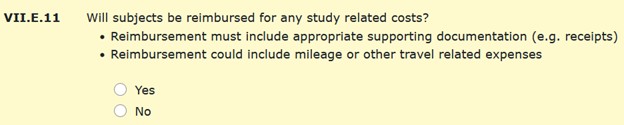
If a research team will be providing reimbursement, specific requirements will need to be met including collecting receipts and issuing appropriate tax document and appropriate paperwork, including receipts must be collected.
Additional information is provided on the HSO website pages Research Subject Reimbursement and Research Subject Compensation. A compensation and reimbursement matrix is also available to assist in determining when monies paid to research subject is considered compensation or reimbursement.
Part 11-Compliant eConsent
By Sandra Ahrendsen, Senior Business Analyst, ICTS
Informed consent is one of the most critical aspects of human subjects research. It ensures participants understand the study, its risks, and their rights before agreeing to take part. To support this process, the University of Iowa recently implemented a Part 11-compliant electronic consent (eConsent) feature within the ICTMS electronic regulatory (eReg) application.
eReg eConsent is a secure, electronic method for obtaining informed consent. Instead of signing a paper form, participants review and sign the consent document electronically. This approach allows researchers to interact with the individual(s) and conduct the consent process remotely, which can be especially helpful for participants who live far from the study site or have limited mobility. Participants can also take time to review the consent form and consult with trusted individuals, such as family members, friends, or their physicians, before signing.
At the University of Iowa, eReg eConsent is used specifically for FDA-regulated clinical trials involving drugs or devices. It is integrated into the eRegulatory system, ensuring compliance with federal regulations and institutional policies.
The benefits of using eReg eConsent are significant. It improves accuracy by ensuring participants always access the most current version of the consent form, reducing the risk of outdated documents. It also enhances security by minimizing the chance of lost or misplaced signed forms. Because eConsent is integrated with the eRegulatory system, it streamlines workflows and reduces manual data entry, saving time for research teams. Finally, eReg eConsent offers convenience for participants by enabling remote consent and allowing them to review information at their own pace, with the flexibility to consult trusted individuals before signing.
To learn more about the eConsent process and how to implement it in your study, visit:ICTMS Resources | Institute for Clinical and Translational Science - The University of Iowa
Part 11 Regulations and HawkIRB Consent
The Code of Federal Regulations (CFR) Title 21 Part 11 sets requirements to ensure that electronic records and signatures are “trustworthy, reliable, and equivalent substitutes” for paper records with ink signatures. These regulations also outline the appropriate security and management of the computer systems that are utilized in the management of electronic records in research.
Electronic Consent Requirements
When utilizing an electronic informed consent (eIC) the document must contain all elements of informed consent required by HHS and/or FDA regulations (45 CFR 46.116 and 21 CFR 50.25).
It is important that any eIC should be easy for potential participants to review, including the ability to scroll forward and back, and to pause and then return to complete later. Depending on the study population, it may be appropriate for investigators or research personnel to assist participants in navigating the electronic form.
The regulations found at 21 CFR part 11 require that an organization verify the identity of an individual before it accepts an individual’s electronic signature. (Note: FDA regulations do not specify any particular method for verifying the identity of an individual and accepts many different methods.)
Management of Electronic Records
For FDA-regulated clinical investigations, the electronic system that supports the eIC must be secure with restricted access (see 21 CFR 11.10 and 11.30) and should include methods to ensure confidentiality regarding the subject’s identity, study participation, and personal information after informed consent has been obtained.
IRB Approval
At the University of Iowa, eReg eConsent is available specifically for FDA-regulated clinical trials involving drugs or devices. It is integrated into the eRegulatory system, ensuring compliance with federal regulations and institutional policies. The University of Iowa’s Part 11-compliant electronic consent (eConsent) feature is available within the ICTMS electronic regulatory (eReg) application which is found on their website. The HawkIRB application must integrate with OnCore to utilize the eConsent tool, either question V.22 (for oncology) or V.27. (for non-oncology) in the HawkIRB application must be checked “Yes.” VII.D.16 must also select “by electronic consent” and describe the use of eReg in the free text field so the IRB can approve the use of obtaining informed consent via electronic means.
The investigator should submit to the IRB copies of all forms (electronic and paper forms) which the subject will receive and view during the eIC process. The investigator must obtain IRB approval for any subsequent modifications to the study-related information, whether electronic or in hard copy (see 45 CFR 46.109 and 21 CFR 56.109). OHRP and FDA recommend that an investigator discuss plans for using eIC with the IRB before finalizing development of the eIC to ensure that the IRB agrees that such a format may be used for the applicable research for obtaining informed consent.
For information about Part 11 compliant eIC at the University of Iowa, see this article in this month’s IRB Connection newsletter.
To watch a recorded presentation from ICTS on eConsent, visit Office Hours & Resources | Institute for Clinical and Translational Science - The University of Iowa. Scroll to the “Review Monthly Informational Meeting Content” section.
See also these UI Educational Tools:
Electronic Informed Consent Checklist
Additional Resources:
Training Changes for Documentation in a Subject's Medical Record
All clinical researchers or research staff who associate subjects in the EPIC medical record have been required to complete two separate training courses. The two courses have been combined, and the required training is now a single course titled, “E0092 Epic Documentation for Research Students, Staff, & Faculty."
The training covers how to request an Epic Research Study Description build and how to associate patient/subject participation in research. All research team members who are assigned to document in the subject's medical record must complete this training.
Additional information can be found on the HSO Website under Record of Consent. Specific details on how to register and complete the training requirements can be found on the Institute for Clinical and Translational Science website under “Documenting Subjects in Epic."